Section A01
Week 7
While the theme of this week pertains to academic freedom and its supposed threats, this specific article,"The Coddling of the American Mind”, is quite closely related to last week's theme of mental health, and what I find quite relevant to our contemporary political climate. Authors Greg Lukianoff and Jonathan Haidt argue that the increasingly pervasive use of “trigger warnings” and “safe spaces” in academic settings acts as a resurgence of political correctness, and threatens intellectual freedom within these settings. In these settings, trigger warnings and safe spaces have both been used to shield students from reexperiencing trauma, and to protect students from violence. The authors also argue that this culture of coddling of the mind, and the nurturing of “hypersensitivity” within students, is counteractive to addressing mental health issues. They assert that the quickness to foresee harm and danger through the “fortune telling” phenomenon, and the preemptive, protective measures that academic settings currently take do not follow the necessary “exposure therapy” needed for those who experience mental health issues to readjust to the “real world.” However, these authors’ arguments homogenizes and oversimplifies the complexity of mental health altogether under a “one solution fits all” model, as if every person who struggles with mental health issues (esp. classified illnesses like PTSD) can heal through a gradual, exposure therapy. This approach isolates mental health away from its intricately tied social and cultural contexts, like the specific Asian American experience with mental health, and describes these issues simply as “sensitivity.” The authors assert that the “real world” is harsh---that the coddling of students in safe spaces doesn’t prepare them for such a world. I would argue that the “real world” contain the social and cultural contexts that shape these mental health struggles, and these contexts include a long history of injustice, oppression and pain, especially for minorities. The authors’ simply pointing the finger at the individuals’ suffering as “oversensitive” doesn’t adequately address the injustices of the “real world.” Their inadequacy to address this fact, and their acknowledgement of the “harshness of the real world”, reinforces the importance of creating safe spaces inside such a world. In addition, every individual’s needs to healing from their traumas is different. Safe spaces provide a space for individuals to be vulnerable, and be uncomfortable so they can push themselves to grow on their own accord (the goal of an academic setting), but not feel like their lives are in danger. While I agree that “trigger warnings” for the most trivial words within academic settings may be not be the most effective, I argue that the authors’ nitpicking of past “trigger warning” and “safe space” usages negates the effectiveness and need for both trigger warnings and safe spaces. These spaces and actions allow students (esp Asian Am) to recognize their own vulnerabilities, heal from their traumas, and unapologetically speak after being previously silenced, all on their own accord.
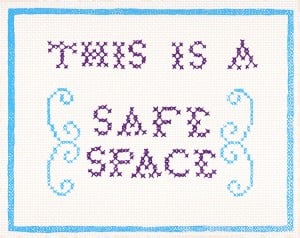
Question: What's the harm in holding your tongue/thinking twice about what to say? Is the sense of superiority over vulnerability really a valid reason to condemn safe spaces?
References:
Haidt, G. L., & Haidt, J. (2015, November 20). The Coddling of the American Mind. Retrieved May 11, 2017, from https://www.theatlantic.com/magazine/archive/2015/09/the-coddling-of-the-american-mind/399356/

No comments:
Post a Comment