A02
Week 7
In the Berkeley Free Speech Movement: Paving the way for campus activism by Robby Cohen, we begin to look at the beginning of student activism. Any acts of non-campus political advocacy were to be forbidden on campus, as deemed by the University. Students seeing this as an infringement on their right to free speech began to raise awareness on the predicament. In 1964, one student, Jack Weinberg, was being arrested for tabling on Sproul Plaza regarding fundraising for civil rights organizations. Weinberg's peers saw this and began rallying on his behalf for his release and a change in the University's ways. This was the birth of student activism on campus which then led to many other protests.
Recently both UC Davis and UC Berkeley had a potential speaker, Milo Yiannopoulos a conservative person whom many deem problematic, come and give a speech. In both situations he was met by opposition by folks who feel that his presence was not welcome on campus. Milo was invited to both campuses by their respective student run republican clubs. Especially in a place where student activism was founded upon the idea of having someone or something restrict your actions and sayings, we get this case.
Q: On what instances does protesting shine the best in? Where does it begin to lose its value?
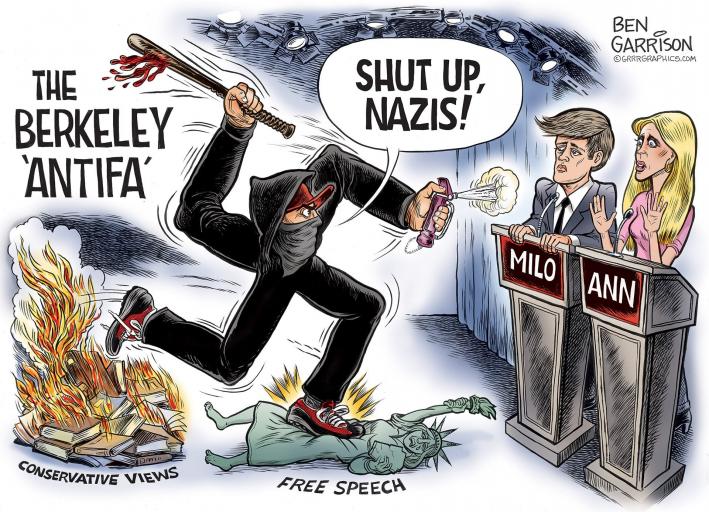
Cohen, R. (1985). Berkeley Free Speech Movement: Paving the Way for Campus Activism. OAH Magazine of History
Berkeley Free Speech Movement [Digital image]. (2017, April 27). Retrieved from http://www.thepubliceditor.com/pc-political-correctitude/universica/berkeley-free-speech-movement/

No comments:
Post a Comment