Sunday, April 30, 2017

Week 5 - Do Won Lee

Do Won Lee
Section 2
Week 5

            The two readings for this week are “Imperial University” by Piya Chatterjee and Sunaina Maira and “Empire of Death and the Plague of Civic Violence” by Darrel Hamamoto. In “Imperial University” Chatterjee and Maira discuss the relationship between United Sates universities and the country itself. How their special relationship formed during the wartimes of the 20th century. The United States benefited from universities in their research in weaponry amongst other fields that would give the United States advantages against other countries in times of conflict. As a result, universities needed to maintain order against oppositions to this symbiotic relationship. Protest of the representatives of the allies of United States was not tolerated, no matter the ethics nor morality that they may have. In addition to this, protest of the U.S.’s interests in imperialistic acts are not tolerable as well. Hamamoto’s “Empire of Death” dives further into the effects of U.S. imperialism, specifically the domestic side. Hamamoto lists murders that happened to people living in the United States, caused people, particularly men, that have relations to the U.S. military. Hamamoto’s piece describes the violence embedded into the minds of those with military experience, or those impressioned by people with military experience. The wars in Asia that the U.S. were involved in due to the Cold War left many veterans with burning passion to cause violence against the people they fought and also protected.

            Imperial University is a university that is not allowed to speak out against the imperialistic intentions of the United States. If anyone were to protest against such intentions, they would be met with violence and militarized retaliation. Despite the U.S. military being a factor for such protest, it is used on the civilians that they so claim to protect. This domestic violence will continue to exist as long as the United States remains intent on imperializing and controlling foreign affairs. 

My question is, what would go on inside your own head if you were in the positions of the politicians and higher ups and have to make a decision that would affects both other countries and also the universities of your country?
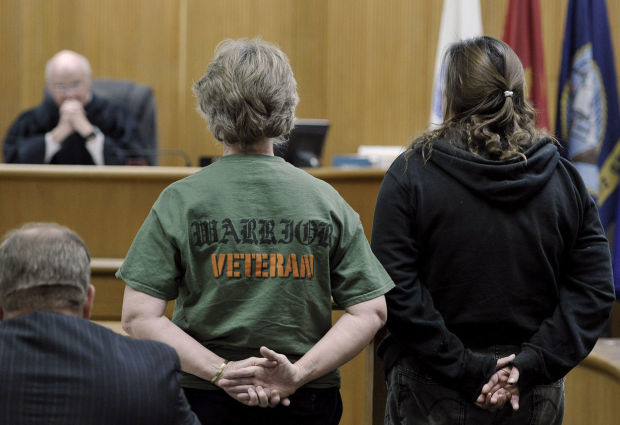

Acharlton@santamariatimes.com, A. C. (2014, February 10). Vets court becomes lifesaver. Retrieved April 30, 2017, from http://santamariatimes.com/news/local/crime-and-courts/vets-court-becomes-lifesaver/article_cfd0b0e4-9211-11e3-9788-001a4bcf887a.html

Week 5

Kimi Villaroman
A01
Week 5

Darrell Hamamoto’s article “Empire of Death and the Plague of Civic Violence” hypothesizes that there is a causal relationship between the rise in homicide (serial killers and mass murderers) and the highly militarized post-war US culture. He brings up multiple killers, emphasizing reasons such as “economic uncertainty…and resentment against non-white minorities” (279) because they steal their jobs. I find this interesting for two reasons: 1) post-war, it can be difficult for those in the military to find jobs and economic stability, and 2) there is statistic evidence that immigration actually boosts our economy. To address the first point, as a Filipina American, I find it gross that the American government promised fortune to the Filipino veteranos who fought in World War II; yet they are uncared for, monetarily and personally, in today’s world. For all who fought in war, it should not be so difficult to find jobs. Why are so many veterans homeless? I am privileged to be a part of a community that cares for these veteranos when the government has failed to do so. As for the second point, in high school, I did a research paper on the effects of immigration and how it benefits our US society. With the influx of people, millions were added onto the labor force, creating a boosting economy. The grossly misleading reason why white people believe that we are taking their jobs is that while the unemployment rates for minorities have improved within the last decade, unemployment rates for white people have remained stagnant. This is largely due to the declining Baby Boom labor force and the increasing amount of minority births; not because we are “taking their jobs.” Another facet about the chapter that I found interesting is the case of Konerak Sinthasomphone, in which he was “returned to his boyfriend” after being found naked on the streets. The type of bigotry and ignorance that yellow people had to face thirty years ago boggles my mind because I know that in today’s society, that would NEVER be tolerated nor would happen. Also, I would like to highlight Reeves story with the Asian bride service. It is extremely common for Filipinos to force their daughters into marriage to gain economic status, as is the case of Emelita Villa. I am proud of the fact that more Filipinas are empowered in today’s age, yet this Asian bride phenomenon still remains a pertinent issue in our society back in the homeland. While I hate this fact, I am grateful that Hamamoto brings up this issue in his chapter.

Question: What are other unknown injustices against Asians that the government has hid away from the public?


Reference:

Hamamoto, D. Y. (2003). Empire of Death and the Plague of Civic Violence. In Masters of War: Militarism and Blowback in the Era of American Empire (1st ed., pp. 276-292). New York, New York: Routledge.

[Race of US Mass Shooters, 1982-2013]. Retrieved 30 April 2017 from http://www.dailykos.com/story/2015/7/24/1405403/-Lafayette-Shooter-was-Confederate-Flag-bearing-Tea-Partier-who-Hated-Liberals.

Week 5 / Melanie Manuel / A03

Week 5 / Melanie Manuel / A03

In Piya Chatterjee and Sunaina Maira's Imperial University: Academic Repression and Scholarly Dissent, I learned what exactly was the "imperial university". Prior to reading this paper, I actually had no prior knowledge as to what it was though as I continued to read through the forty-three page paper, I found familiarity in my everyday academic life. The imperial university is not a subservient concept meant to undermine the academy, but rather continues to fuel this inherent need for control. It controls what is taught and what is researched. It constrains the worldly topics that our own doctrine ironically labels as "worldly views". Members of the academy and even members of our own government implement this excessive use of controlling the narratives that get shared by hiding behind the term "academic freedom," which isn't as freeing as we think. And perhaps it's to save themselves for fear of what the truth may do. Or it is a way to keep their control over the people because some people overlook these facts.


More often than not, there is always two sides to an argument. When the general public is presented information, it is up to us to take a stance on the argument from what we're given. On top of this, we must remember to research both sides of the argument to understand the topic. However, from what I've interpreted from the article, is that it's pretty damn hard to believe what you read when it's probably being controlled and tampered with anyway. And I suppose that's our own poison to choose from, and that what we choose to do should is learn as much as we can in any way that we can to avoid the plight of ignorance that this world quite blatantly suffers from.

References:
Chatterjee, P., & Maira, S. (2014). Imperial University: Academic Repression and Scholarly Dissent. Minneapolis: University of Minnesota Press.
Jensen, Jacob. (2014). [Calvin and Hobbes comic strip about perception]. Retrieved from https://hellomynameisjacob.wordpress.com/2014/06/11/art-and-perception/

Questions:
Will the imperial university always rule our education? What can we do with the information we have now?

Victor Martinez Week 5

Victor Martinez
Section A02
Week 5

The readings for this week bring up some very relevant questions about the nature of patriotic attitudes and activism. It’s not surprising how activists are condemned as radicals for speaking up against atrocities committed by the USA in the post 9/11 world. Former president Bush helped create a mindset that the world was black and white and that America could do no wrong. This sort of attitude stands in strict opposition to the ideals on which America is supposedly founded on. America is supposed to be loyal to the people and the people are supposed to have the right to stand against a tyrannical government. We’re even given that right explicitly in the first amendment of the Bill of Rights. We can petition the government and are promised free speech, so it’s especially egregious how public discourse is constantly shut down under threat of violence. America has committed several crimes against other nations, and the citizens should be allowed to voice their critiques about this practice.

Instead patriotism is being used as an excuse to silence opposition, and hide the criminal actions of the US military abroad. The reading about Imperial University really highlights just how the institution of the university once again caves to moneyed interests and attempts to dissuade activists. The obsession with appearing as American as possible is crushing debate, and that goes against the idea of democracy.


Question: How can students reclaim their right to free speech to reveal the hypocrisy of the universities?


References
Chatterjee, P., & Maira, S. (2014). Imperial University: Academic Repression and Scholarly Dissent. 
[Propaganda Questions]. (2017, April 23). Retrieved from https://ajmacdonaldjr.wordpress.com/2010/04/23/propaganda-and-the-people/


Week 5- Elizabeth Chang

Elizabeth Chang
Section A01
Week 5


The article “Empire of Death and The Plague of Civil Violence by Darrell Y. Hamamoto talks about how brutal murders and the rise in civil violence is becoming more and more frequent, and therefore not surprising anymore. Due to the frequency, people now think of it as something common and mundane. Darrell Hamamoto also describes and explains a variety of violent acts and murder types, and giving situational events like wars. All the examples given are historical facts that have had an impact on different racial groups. After reading this article, I realized that a person’s race really does have an impact on the violent acts that occur. The reason of many of these violent acts have roots in a person’s race, meaning that if they did not look a specific way, the crime might not have occurred. When I read about the story of serial killer Ramirez in the “Highway to Hell” section, I realized that because the killer was targeting Asians, the people of other races who lived in the same neighborhood as Asians would be “safe”. I find it very sad and unfair that the safety of the same neighborhood changes depending on the resident’s race. Most people’s views towards a specific ethnicity is due to their own experience with them, but the bad actions of one or two or even twenty people of the same ethnicity does not represent the whole country. This is why not having stereotypes and generalizing communities is so important. It affects their well-being.


What is a good way of trying to minimize stereotyping to help other people’s well-being?

References

Hamamoto, D. Y. (2003). Empire of Death and the Plague of Civic Violence. In Masters of War: Militarism and Blowback in the Era of American Empire (1st ed., pp. 276-292). New York, New York: Routledge.


Contemporary Police Brutality and Misconduct: A Continuation of the Legacy of Racial Violence. (2001, March 21). Retrieved April 30, 2017, from http://civilrightsteaching.org/resource/contemporary-police-brutality/

Week 5 Joanne Agus

For this week's reading, "The Empire of Death and the Plague of Civil Violence" by Hamamoto explained the full story and aftermath of wars, especially focusing on the Vietnam wars (Hamamoto, 2013). Furthermore, the Imperial University by Chatterjee and Maira discusses about how censorships is formed in institutions, like Universities, through the values of American Imperialism (Chatterjee & Maira, 2014).

Hamamoto's articles stood out the most to me because I could see how prevalent it is that governments utilize history classes to "brainwash" and doctrine students to shape their nationality. I personally went to a private high school in Indonesia and have had history teachers from all around the world, which helped me have a broader and less bias view of other countries' history. I've also had the privilege of visiting Vietnam's War Remnant's museum twice and toured around Vietnam with my school friends to learn more about the culture. From there, I've learned the tragedy of the Vietnam war is still being prolonged because of the mutation and disabilities that the Vietnamese people are suffering from, from the different chemicals or "herbicides" (honestly they're poison) that the Americans used during the war. When I first learned about it, I didn't know that other chemicals like Agent Purple and White even existed, nor did a lot of other Americans know before I told them about it. We only mostly knew about Agent Orange, and although that was deemed to have the most effect, forgetting to mention these other chemical weapons softens the image of brutality and inhumanity of the American government during the time of war. I have also occasionally talked to some of my american friends about this particular war, and most of them either denied, or have no idea about the post war effects that the Vietnamese people are going through. This lack of detail in history is what makes us, human beings, less united and more separated by our "nationality".

Q: And so, maybe this is the time that we question how we define our nationality, and learn more about our history before rooting of ideas based on non-holistic pieces of information.


(War Remnant Musuem, n.d.)
References:

Hamamoto, D. Y. (2003). Empire of death and the plague of civil violence. In Boggs, C. (Ed.), Masters of War: Militarism and Blowback in the Era of American Empire (pp. 272-296). New York, New York: Routledge.
Chatterjee, P., & Maira, S. (2014). Imperial University: Academic Repression and Scholarly Dissent. Minneapolis: University of Minnesota Press.

War Remnant Museum (n.d.). Exhibitions [digital image]. Retrieved 30th of April, 2017 from http://warremnantsmuseum.com/exhibititons