Monday, April 27, 2015

From Saigon to Baghdad


Yun Ting (Claudia) Chao
ASA Section 2
Week 5

From Saigon to Baghdad

After reading Andrew Priest's article “From Saigon to Baghdad: The Vietnam Syndrome, the Iraq War, and American Foreign Policy,” I felt that it was interesting to see that the “textbook” response to this incident was different at different types of schools or curriculums. Some curriculum heavily criticizes the United State’s foreign policy in butting their heads in everybody’s businesses, some taught this part of history in a lighter approach, giving constructive criticism and suggestions on how America could have done to lead to victory, and others taught history without really focusing on international affairs, and just focusing on domestic affairs. To be honest, maybe I just do not notice historical events that much, but I actually did not know that the United States lost in the Vietnam War. I try to recall what my history classes taught me in high school, but I genuinely could not remember much about Vietnam. My question would be, shouldn’t curriculums present the whole truths to students, and leave the analyzing and opinion forming to students?

p.s. I posted this before the deadline but somehow the post disappeared when I checked again? So here's a repost. Sorry if there's a duplicate. 


Sunday, April 26, 2015

Empire of Death and the Plague of Civic Violence

Daniel Lum
ASA 2 Section 2
Week 5 Blog

In response to Hamamoto’s “Empire of Death and the Plague of Civic Violence” I really understand the point that is trying to be made and i agree with the odd culture that we live in. The forms of entertainment that are around is very interesting and proves the author's point. Videogames are about killing other humans or decapitating other living things. Videogames are also one of the main forms of entertainment that today's children use so this odd culture will continue. Also hollywood has released several movies such as american sniper and american horror story and Dexter that proves this fascination with killing is a huge money maker explaining the amount of attention these types of actions have. Oddly I do not think this will change anytime soon.

Is there a way to curve the next generation of children away from these things?

Empire of Death and the plague of Civic Violence

Yi Zhou
Section 002
ASA 001
Week 5 reading

The article “Empire of Death and the plague of Civic Violence” introduces several different types of murders and their background. I have noticed that there are two similar cases, one is Ted Bundy and one is Kdmund Kemper. They were both very good students in their academic work. They both had very high IQ and are “good students” in others views. However, because some bad memory or experiences in their childhood, they became very crazy and chose to kill people instead of normal life. There are also some similar people in China. One famous case is Jiajue MA. He was a good student with high academic scores in the university. However, the poverty and bad experience in his childhood made him very sensitive. He thought everyone was laughing at him when he talked. He killed all his roommates and finally caught by police. According to these cases, childhood experience is a very important element to people’s personality. Some “High GPA” students may have dark and crazy inner side.


Question: Could we differentiate murders from normal people in daily life?

Empire of Death and the Plague of Civic Violence

Reading Reflection #5
Melody Ly
Section A01
April 26, 2015


I felt the biggest take away from this chapter written by Darrel Y. Hamamoto is that because of over-militarization in our society, people have become more desensitized to acts of violence against other people. Statistics included show a positive correlation between the two. I think this is important to discuss because a mere few months ago, our own community’s police department was gifted a military-grade tank. We should think about this: in Davis, population of 66,000, is there a logical need for an army weapon? Rumor has it is that it’s to protect the police in dangerous situations, but the people argue it has been acquired to be used against peaceful protestors should even the slightest noise be made. If a relatively quiet college town like Davis was able to get a tank, what kinds of weapons used in the military could more liberal cities like Boston, New York, or San Francisco acquire to be “used to protect the police in dangerous situations?”

Vietnam Syndrome, Good or Bad?

Amy Hoang
Section 1
Week 5

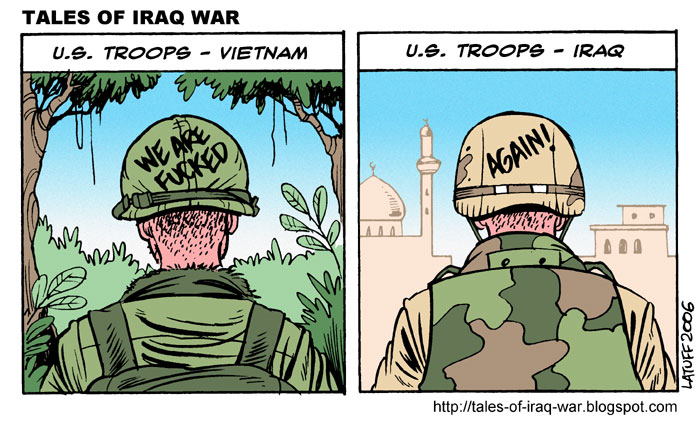
After reading Andrew Priest's article “From Saigon to Baghdad: The Vietnam Syndrome, the Iraq War, and American Foreign Policy,” I realized the Vietnam War is like a huge rock that dropped into a lake that is America, crushing everything in its path at the moment, and creating a ripple effect that impacts contemporary social, economic, military, diplomatic, and political issues. Today, Americans tend to choose to avoid war rather than advocate it, because they fear losing troops and suffering the aftereffects of a pointless, lost war like Vietnam's.
There are two reactions to the Vietnam Syndrome: 1) policymakers have learned some wrong lessons from the war, causing them to be too timid in applying military power around the globe; and 2) it's a good thing because it puts a limit on the excessive American military power. Because of the Vietnam Syndrome, Americans are reluctant to enter war with Iraq, fearing “another Vietnam.”

Question: Has the Vietnam syndrome affected America's foreign policy in a good or bad way? Is it better for us that we are putting less emphasis on military?

Below is a political cartoon comparing the Vietnam War to the War on Terror:

Empire of Death and the Plague of Civil Violence

Samuel Sugimoto
Section A01

Empire of Death and the Plague of Civil Violence

            Hamamoto’s “Empire of Death and the Plague of Civil Violence” discusses the many different types of murder that occur in society.  I would like to believe that society is not based on murder, rather that murder is imbedded in human nature, partially primitive, partially morbid curiosity.  Humans still have not given up their “kill or be killed” nature, which is a relic of our prehistoric past.  Sometimes, that nature takes over a person, combine it with how rarely people come across death in everyday life and people can lose track of their moral compass.  When it comes to wars, the “kill or be killed” mentality is on full display.  Soldiers are always on high alert, and are trained to immediately eliminate any immediate threat.  And when soldiers are fighting a winning battle, the power gets to their heads, and they no longer see the human in their fellow man.  It is then that genocide and killing of innocent civilians become commonplace.


Question: Should military training and/or civilian education be revised in an attempt to lessen the probability of soldiers committing genocide and other war crimes.

Nanking Massacre

Week 5: From Saigon to Baghdad

Kristina Nguyen
Section 2
Week 5

I have always questioned the Vietnam War and the history surrounding it. There's definitely many sides to what happened and how it was handled. I like articles like "From Saigon to Baghdad" because it gives us an inside scoop of the general view of the war and reaches down to specific cases. It really made me realize that this war did haunt a lot of people, and it continues to. It just also made me realize that there are still a lot of wars going on right now and this trauma is still going on. For example, everything that is going on in Baghdad. Sixty years from now, are the new generations going to look at this war and feel what we did about the Vietnam war?

This is a picture of the Vietnam War Veteran Memorial which sends a very powerful message. All gave some...and some gave all.. as one of my past advisor who was a Vietnam war veteran says.