Sunday, April 27, 2014

U.S. Intervention Post-Vietnam

Jonathan Apostol
ASA2 Section A01
Reflection #5

Response to From Saigon to Baghdad: The Vietnam Syndrome, the Iraq War, and American Foreign Policy by Andrew Priest

The topic of the Vietnam War continues its prominence in U.S. history and becomes a time period for which to question and criticize the United States' methods and procedures during wartime. After the war ended, literature analyzing its debilitating effects on the culture of the U.S. and on the minds and bodies of the soldiers and civilians involved circulated quickly. The Vietnam War brought the government to realize the dangers of its then interventionist approach to foreign policy and motivated a change in the goals of U.S. foreign policy to become less interventionist. Despite this, the U.S. continues to reinforce its imperialist policies by attempting to establish its "presence" in every geographic region, whether by diplomacy or force. In particular, examining the recent events in Iraq, many can question the motivations behind U.S. involvement in the Middle East. Although vastly different from the Vietnam War in terms of its costs in human life, one must also bring attention to the once again growing imperialism of the United States that was criticized so long ago. With the now greatly diversified population of the United States, it will now be up to us, the citizens, to combat the imperialist actions that the United States will likely pursue in the future. We must stand together, cross-ethnically and transnationally, to prevent such tragedies like the Vietnam War and the similar loss of life during the Iraq War.
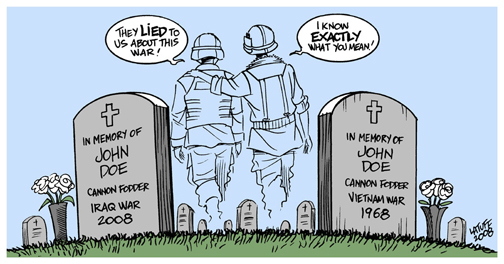

1. How does the Vietnam War compare/contrast from the Iraq War?

The Effect of the Vietnam War

Jimmy Nguyen
ASA 2 Section A01
Reflection #5: From Saigon to Baghdad
4/27/14


Personally, I strongly believe that war is stupid, unnecessary, and could be complete unavoidable. No one truly wins in wars and wars only cause despair throughout the world. This despair transcends races, locations, and even time itself. More than 30 years after the Vietnam War, we find ourselves referring back to the tragedy that was the Vietnam War when new war arose with Iraq. After reading this article, I learned that the war had affected the world more than I thought. The world, mainly the US, became more paranoid after this power struggle. Was there truly a point to this war? Did we lose a lot more than we gained? We fought this war to try to get into good standing with Vietnam and protect its rights; instead, there is still conflict between us. The Vietnam War truly effected the US negatively. With the outbreak of the Iraq war, people started to compare the two together. A repeat of this devastating war would be too much for the US and the world to handle. I was pleased to read that following the Vietnam war, the US attempted to fix their foreign policy in order to avoid future foreign disasters. Although this did not go entirely as planned, the fact that the US started to learn from their mistakes brought me relief. The Vietnam Syndrome that affects the US is apparent and still active today; we are crippled by our mistakes years ago. Although we are slowly fixing ourselves, I believe that the Vietnam War and its effects will never be forgotten. However, that doesn't mean that we shouldn't try. As shown by the Vietnam War, war is terrible and affects everyone significantly and drastically. If we as a world can work together to stop war, then maybe peace can be obtained.

How different would the US be today if the US never participated in the Vietnam War? How different would the US be if we actually WON the Vietnam war?

Once A Hero, Always a Villain.


The things people would do in this world is undeniably disgusting and wrong. The deeper I went the more sorrow I felt for the victims of the murderers. One thing that I found utterly profound was the murderer's motives and background like Sergeant Jack Wayne Reeves who was a man of military; a man of honor as one would believe an commanding officer would be or at least I did. He murdered all three of his wife and kept them as sex slaves. If things couldn't get worst Ricardo Munoz Ramirez was brought in to the picture and what he did would have to be way worse than what Reeves have done to his wives. The man killed many Asian American males and raped their wives afterwards, sometimes he would kill them as well! What's even terrifying is the fact that he was influenced by his cousin, Mike, who told him his stories of raping, murder, and mutilation when he was a Green Beret in the U.S Special Forces! I find it unbearable to believe that these people who are considered "heroes" come to a conclusion that their actions are validated. In addition to that they get away with it for a long period of time! I can't stand the fact that the majority of these serial killers are Caucasian and they could get away Scot-free.

Question: As an Asian American, are we really "safe" in our society? Just what could possibly be ways to prepare for situations like the Reeves and Ramirez incidents? Can we still look at those veterans as heroes again or any other veterans the same way? 

Response to Empire of Death and the Plague of Civic Violence by Darrell Y. Hamamoto.

David Le 
ASA 02 
Section A01 
Blog post 5 

Response 4

Name:Weitang Liu
Blog #4


The article "A Tale of Two Campuses: Berkeley and Davis respond to Occupy movements" shows different ways of solving the similar problems in their campuses among two UCs. I can sense the authors angry by his comparison between those UCs. By drawing the parallel that UC Berkeley focuses on solving the problems of high tuition and fees, while UCD chancellor only complained about the budget cutting in recent years and accused the students of damaging, he made the point that  "Why Davis chose to ignore this issue in its public communications about damages caused by the Occupy students, while Berkeley ignored any such damages and responded to the need for lower costs of education remains a mystery.
" I think he somehow feel angry and sarcastic towards the things UCD administrators did. 


When I google online, I am very surprised by a recent news titled as "UC Davis pepper-spray officer awarded $38,000" written by Joe Garofoli.  I think it is very self-explanatory. I do not understand why the police was awarded because his violence towards the students. I am not saying that the students were 100% doing right, but the polices were only "doing their jobs" ordered by the university administrators.  

Question: Is there any real differences as more administrators come into play? 

Mirrored Killings: Imperialism's Reflection Impacts Home

Cheyne Fujimoto
ASA2

Dr. Darrell Hamamoto's chapter, "Empire of Death and the Plague of Civic Violence", was an interesting perspective. Particularly interesting was Dr. Hamamoto's use of shocking events and descriptions to drive the idea that such terrible events could only come out of a primary cause: the embracing of militarism (which in itself according to Dr. Hamamoto is a result of imperialism) in American culture. It was quite effective, as I found it difficult to read the article mostly because of how completely grotesque it was.

I believe that the larger problem is a result of the inadequate support at the early stages of the development of serial killers and mass murderers and not as much from imperialism. However, Dr. Hamamoto does make an excellent point in highlighting society's fascination in killing in all of its forms. Clearly, the causes of such monstrous killers are not plainly black and white but Dr. Hamamoto helps to paint the connections of these events to a war-mongering society.

Question: Is America better off not involving itself with global affairs or will it breed complacency? 


Photo of American soldiers in Vietnam with a skull presumably from enemy dead.

Objectification of Human Life

Esther Ho
Section A02
Reading Reflection #5
In response to: "The Empire of Death and the Plague of Civic Violence" - Hamamoto
Objectification of Human Life
The article, “Empire of Death” was by far the most gruesome and painful article to read. As I read the continuous vivid and detailed accounts of murders, I questioned whether it could get worse. Sadly, the answer was yes. At some points, I didn’t think I was able to finish the article because the stories were getting increasing gruesome and inhumane. But as I continued, I found myself angered and speechless at the actions that one would commit against another human being.
The account that stood out to me was the one about the 7-year-old child that was tortured, raped, and sodomized. She was only seven! I could not wrap my head around the justification of such action. The other one that I found painfully disturbing was the cases executed by the perpetrator, Richard Ramirez. The fact that he saw the slaughtering of human beings as a form of pleasure because of his cousin’s accounts of rape, murder, and mutilation of Vietnamese women during the war makes me realize the broad spectrum of the aftermath of violence in war and elsewhere. The motives of the murderers were not only linked to immediate experience in the Vietnam War, but also the precipitated accounts of the actions committed during the war.

It was sickening to read that those who are portrayed as “heroic” have committed such crime to the civilians of those of another country. I cannot bear the fact that they take pride in their torturous schemes that they have inflicted on another human being. What gives them the privilege to have complete control and power over someone else’s life?

The continuous accounts of the white male perpetrators’ crimes against “yellow people” highlighted the social distance are held between races. They perceive the “yellow people” as objects, rather than equal human beings. They seem to have projected their mindset of Asians that they have tortured and belittled during the war (or what they were told to have happened) onto the Asians that are in their own country. I cannot help but feel angered that our lives are not treated as anything significant, but rather as an object that could feed into a person’s murderous fantasies.


The fact that “killing” gives the perpetrator a sense that they are “living” is a paradox. Do you think this mindset is nature or nuture?
Victor Chen
The Evolution of Deadly Racism

Racism is something that everyone, of any color or background eventually will face.  Discrimination is predominant and there is almost no place in the world where it is avoidable.  The more specific topic this week pertains, of course, to Asian American racial murders and killings due to propaganda and nationalist impulses.  I won't go into any details about the mass murders because I personally don't believe in accidental glorification of any of these criminals but the fact that the previous generation of Asians faced an imminent threat to their safety and still pushed their careers and lives forward despite that is one that I should appreciate beyond anything.  Why does racism even have to exist? what should we do to wipe it out?